How To Visit The DMZ From Seoul: Everything You Need To Know

Visiting the DMZ had been high on my list for as long as I can remember. I have always been curious about North Korea and a tour of the DMZ is one of the most popular things to do when visiting Seoul. It is certainly the closest that most of us will ever get to being in this mysterious country and the experience offers a fascinating and surreal look the history of both North and South Korea as well as the present day reality.
The Korean Demilitarized Zone which is more commonly known as the DMZ is a controlled area that stretches across the entire Korean Peninsula near the 38th Parallel separating the two countries. It was created on the 27th July 1953 when the Armistice Agreement was signed during the Korean War. The DMZ is 160 miles long and 2.5 miles wide and in the centre of the DMZ lies the Military Demarcation Line which is the actual border between North and South Korea. Despite the area being one of the most heavily guarded and militarised regions in the world, the land there has remained untouched for decades and as a result has become a haven for nature and wildlife and many endangered species can be found there bringing unexpected beauty to a very strange place.
Access to the DMZ is tightly restricted and you cannot just turn up on your own. The only way to visit the DMZ is through an official guided tour. There are so many different tour options from half day to full day trips which pick up at various spots across Seoul and choosing which one to do can be difficult. I have written this blog and travel guide and tried to include everything that you need to know when visiting the DMZ as well as all up to date details, advice, photos and any other useful information that you need to know before your trip.
When we first sat down to try and decide what DMZ tour to book, honestly none of them sounded particularly interesting to us especially as we usually prefer exploring places independently. However we then saw an option for a private DMZ tour on Klook and it was exactly what we were looking for. It was definitely more expensive than the much cheaper regular DMZ tour but as we had waited so many years for this trip, we decided it was worth the splurge. It turned out to be the best decision especially as we were picked up and dropped off at our hotel in our own large and spacious vehicle and we also had our own dedicated guide for the entire day who spoke directly to us instead of over a microphone to a large group of people.
The above are affiliate links through Klook. Any tickets purchased from these links earns myself a small commission at no additional cost to you.
Another handy thing to know is that the DMZ is closed on Mondays so do not plan a trip then. We visited on a Sunday (as that is how our schedule for our time in Seoul worked out) and it was very busy so I would always recommend booking a weekday tour if you can.
It is also important to know that right now the JSA (Joint Security Area) where the row of iconic blue huts which are used as meeting rooms between the two countries are located and where you you can technically stand in North Korea (albeit inside one of the huts) is currently closed to tourists. This area has been closed since 2023 when a US soldier ran across the border into North Korea. Because of this, it is essential to understand the difference between the DMZ and the JSA and make sure that your expectations are correct as you will not step into North Korea or be able to visit the JSA at this time.
A few days before we arrived in Seoul, our guide Eddie contacted us on WhatsApp. He also confirmed our pick up time and hotel details once again the day before the tour which made everything super easy and completely stress free.
On the morning of our tour, we woke up to sunshine and blue skies and we could not have asked for better weather for our day out. After we had finished our breakfast, Eddie was already waiting for us in the hotel reception and he made sure that we both had our passports with us before we left as every visitor to the DMZ must bring identification as you will not be allowed in without it.
Once we left our hotel in the centre of the city, the drive from Seoul to Paju (the closest city to the DMZ) took about an hour. As Eddie told us all about the history of the two Koreas, I started noticing barbed wire fences and lookout towers on our left and across the water was our very first view of North Korea.


The first stop on every day trip to the DMZ is Imjingak Park which is the closest point to the DMZ that you can reach without going through any military checkpoints – you can even visit Imjingak without a guided tour if you had your own transportation. It was a very strange first impression of the DMZ as it looked like the entrance to a theme park with a giant car park, fairground and even a cable car.
Eddie took both of our passports and joined a short line to get our tickets to enter the DMZ as even though we had booked a private guided tour, we had to transfer onto one of the official DMZ buses as private cars and taxis are not allowed to travel into the restricted military areas. It was a very quick process (there are also toilets here as well as a convenience store if you need to get a drink) and we were booked onto the next bus which was departing a few minutes later.


A few minutes into the drive and just after we crossed the Imjin River, we reached the first checkpoint of the day at the entrance to the DMZ. South Korean soldiers boarded our bus with a full manifest and carefully checked each passport against the list as well as against each face. We were turned away on our first attempt because two people on the list had not boarded the bus back in Imjingak. After a quick phone call back to base, our driver made another U-turn back towards the checkpoint and we were allowed into the DMZ a few minutes later after going through the identification check once again with the updated passenger list. You cannot take any photos when at the checkpoints however photography is allowed while driving around the DMZ on the bus.
Even as the bus was driving us to our next destination, Eddie kept pointing out things of interest to us both including a blocked off highway that would lead straight to Pyongyang as well as signs warning of landmines in the area – having our own guide made for such an interesting and detailed day. Once inside the DMZ, all tours will follow a similar itinerary visiting the Third Infiltration Tunnel, the Dora Observatory and the Unification Village – though this is subject to change at any time.


Our first stop inside the DMZ was the Third Infiltration Tunnel which was discovered in October 1978 thanks to a tip off from a North Korean defector. It is one of four known tunnels (there could be many more undiscovered ones) dug by North Korea for the purpose of launching a surprise attack on Seoul with the capacity to move approximately 30,000 soldiers per hour through the tunnel. Before entering we watched an informational video about the discovery of the tunnel, the creation of the DMZ as well as the ecology of the area. Eddie then told us even more information about the tunnel and checked if we were happy to visit which we both were. Before heading down to the tunnel, we had to place all of our belongings into free lockers (you cannot take anything with you) and you also have to pass through a metal detector before being allowed to proceed down into the tunnel where we were also given a hard hat to wear.
The Third Infiltration Tunnel is 73 metres below the ground and the full route involves a lot of physical and mental effort. After descending 358 metres down, you then walk 265 metres through the tunnel to where the blockade is located before returning 265 metres back before finally climbing the 358 metres up to the surface. The walk up and down is steep whilst the actual tunnel itself is narrow and damp with water constantly dripping and forming puddles along the way. Sensible shoes such as trainers are essential as flip-flops or heels would make the tunnel almost impossible to navigate.
Once you reach the Third Blockade which is the furthest you can walk, you are only 170 metres from the border which is probably the closest I will ever get to North Korea. There are two more blockades beyond this which reinforce and completely seal off the tunnel before the Military Demarcation Line. There is also a counter here on display showing the number of days since the Armistice Agreement was signed in 1953.
As already mentioned, the space inside is extremely cramped – especially as you get further into the tunnel – which forces you to walk while bent over which can get very uncomfortable. I was so glad to have a hard hat as I knocked my head countless times and I’m only 5ft 6. In fact all you can hear as you make your way along the tunnel is the constant sound of people bumping their hats against the rocks, pipes or on the scaffolding above.
The climb back up is the most challenging part of the entire experience (it was fun looking at the stats on my Apple Watch that day) as it is steep and will leave you completely out of breath. There are signs which will tell you how much further you have to walk and there are also benches along the way where you can sit for a few moments and catch your breath along with a water fountain. The tunnel was definitely hard work which I was not expecting as I had assumed that we would be having a very easy going and relaxed day at the DMZ being driven everywhere. There used to be a little train that transported visitors up and down to the tunnel, but it has been out of service for many years so walking is now the only option.
I would not recommend the tunnel to anyone who suffers from claustrophobia or who has any medical conditions or accessibility issues. However if you did want to give it a try, you can turn back at any point which I saw many people doing. Despite the difficulty it was a great and unique experience but definitely one that I never need to do ever again!


It took us around thirty minutes to get in and out of the tunnel and once we were back outside in the fresh air, there is a small garden area with plenty of photo opportunities. If you decide not to do the tunnel, you can easily spend this time wandering around the garden and taking photos. However be aware that the bus drivers are on a very strict schedule and they will be pointing very firmly at the sign showing the exact time you need to return to the bus and they will not be happy at all if you are late.


The next stop of the tour was the Dora Observatory, where you can clearly see North Korea right there in front of you. It was an incredibly clear day and we could easily see the city of Kaesong in the distance as well as the propaganda village of Kijong-dong. We also saw the giant North Korean flagpole which used to be the tallest in the world (it is now only the ninth tallest) which towers over the nearby South Korean flagpole. Another striking feature was the stark contrast between the landscapes of the two countries. While South Korea appears green, lush and full of beautiful trees, the hills in the North look very sparse in comparison due to much of the vegetation being cut down to be used as firewood because of limited electricity.
I could also see the Joint Security Area (JSA) in Panmunjom in the distance, which as I already mentioned is currently closed to visitors. I have to admit that I felt a little sad that that we were no longer able to visit especially as we had a trip there booked back in 2020. Looking directly into North Korea was a surreal and almost bizarre experience as the isolated and mysterious country that we hear so much (and also so little) about was right there in front of us. While we were at the observatory, we even heard what sounded like a mine exploding or gunshots being fired. Eddie explained to us that sometimes the wildlife in the area unfortunately steps on landmines which causes them to go off.
There is a strict no photo rule at the Dora Observatory at all times and while I did spot many people sneakily taking photos of the view, I did not. I had absolutely no wish to get into trouble inside a military zone and I especially did not want our guide Eddie to get into any trouble either. He always told me where it was okay to take photos and where it was not and I made sure to respect his instructions.


Even though no photos were allowed from the Dora Observatory, we could take pictures in front of the former observatory where our bus was parked. Since I had my SLR camera with me, I was able to zoom past the building and capture a small glimpse of North Korea from the DMZ in one of my photos.


Our final stop inside the DMZ was the Unification Village, a small farming community where a handful of people still live and work the land. Although the residents live under strict rules and a curfew due to the village’s proximity to North Korea, they are exempt from paying taxes and compulsory military service in return. The village has a small cafe and souvenir shop where I bought a fridge magnet and a cold drink.


After leaving the DMZ we arrived back at Imjingak just after 12:30 pm and it was time for lunch. There were plenty of dining options to choose from but I can highly recommend Boston Burger on the second floor. Even though it was very busy, the shrimp burger was delicious and definitely worth the wait.


Once we had finished our lunch, we met back with Eddie and walked over to Imjingak Park where he showed us around and explained everything. The park is full of history and reflection and offers a glimpse into Korea’s past and the ongoing hope for peace and reunification.


Our first stop was the Mangbaedan Altar, a place where to this day, families separated by the Korean War gather on holidays like Chuseok to pay tribute, feel close and “share a meal” with their loved ones still living in North Korea. We also visited a monument dedicated to the song 30 Years Lost, the theme of a television program called Search for the Dispersed Families, which helped reunite more than ten thousand families.
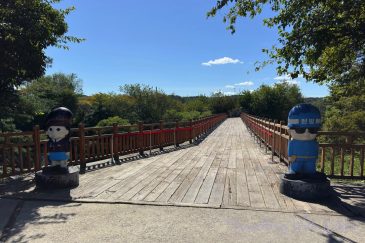
We also saw the historic wooden Freedom Bridge, which is named for the return of 12,773 prisoners of war in 1953 after the signing of the armistice agreement however this should not be confused with the Bridge of No Return, which lies directly on the border inside the JSA and is completely closed to tourists. Nearby there is also a statue of two girls seated on chairs, representing the “comfort women” who were forced into sexual slavery by the Japanese military during World War Two.


There are also colourful ribbons tied along the barbed wire fence containing prayers, hopes and wishes and we also saw the rusted remains of a steam train riddled with over a thousand bullet holes that had been abandoned in the DMZ for many years before being brought to Imjingak Park.


After we left Imjingak the next and final stop of the day was the Gamaksan Suspension Bridge and the drive there took just over thirty minutes. To reach the bridge we had to climb a series of steep stairs and I struggled with them as I was suffering with bad knee pain at the time. I later found out that there is also a longer but easier path if needed – we walked down that way after our visit and I really wished I had known about that path when we arrived.
The Gamaksan Suspension Bridge is 150 metres long and 45 metres high and offers amazing views of the beautiful surrounding mountains and the valley below. As we travelled to South Korea in September, it was not too busy during our visit but I can only imagine how crowded it can get during the busy summer months.


Once we left Gamaksan we drove back to Seoul and because we hit heavy traffic, the journey ended up being almost two hours. As we had booked a private tour, being dropped off right at the door of our hotel felt incredible, especially after such a long and tiring day. I am so happy that we paid the extra for the private tour option – yes it was more expensive but for us, the convenience and comfort made it worth every penny. Having our own personal guide made the whole experience even better and I learnt so much throughout the day. Eddie was amazing and so knowledgeable and he could answer every question we had.
If you are planning a visit to the DMZ, there are a few important things to keep in mind. As already mentioned, wear trainers because I was genuinely shocked by how much walking we did as I had expected a fairly relaxed day out but it was far more active than I imagined. Also bring water and make sure to follow all instructions given by your tour guide and be both respectful and mindful of the place you are visiting. I have also seen people online mention a dress code, but that only applied to visiting the actual JSA however there is no dress code for the DMZ itself. If you are visiting in winter, make sure to wear warm clothes, as Korea can get very cold.
I truly loved every moment of my day at the DMZ. It was interesting, fascinating, educational and it left me wanting to learn even more. For anyone interested in history or politics, the DMZ is an absolute must when visiting Seoul. It is an experience unlike anything else and one I am so grateful to have had. I truly hope to return one day when (and if) the JSA reopens.
I visited the DMZ in 2025 so some information may no longer be accurate or up to date. Be sure to do your own research and check any official websites for the latest details before making any of your own travel plans.
Support Me and Buy Me a Coffee
Follow Me on Instagram
Pin this Blog Post on Pinterest
Follow Me on Bloglovin’
You might also like...
 Everything You Need To Know Before Your First Visit to Seoul
 How to Visit Lotte World in Seoul
 The Full Moon Lantern Festival – Hoi An, Vietnam
 Visiting Shanghai Once Again in Summer 2023
 The Jardine’s Lookout Hike – Hong Kong
 Finally Visiting the Incredible Taj Mahal in India
 Visiting Tai O Fishing Village in Hong Kong
 How to Walk up to The Peak in Hong Kong
 How to Visit Zhujiajiao: Shanghai’s Ancient Water Town
 Shanghai Disneyland Planning Guide